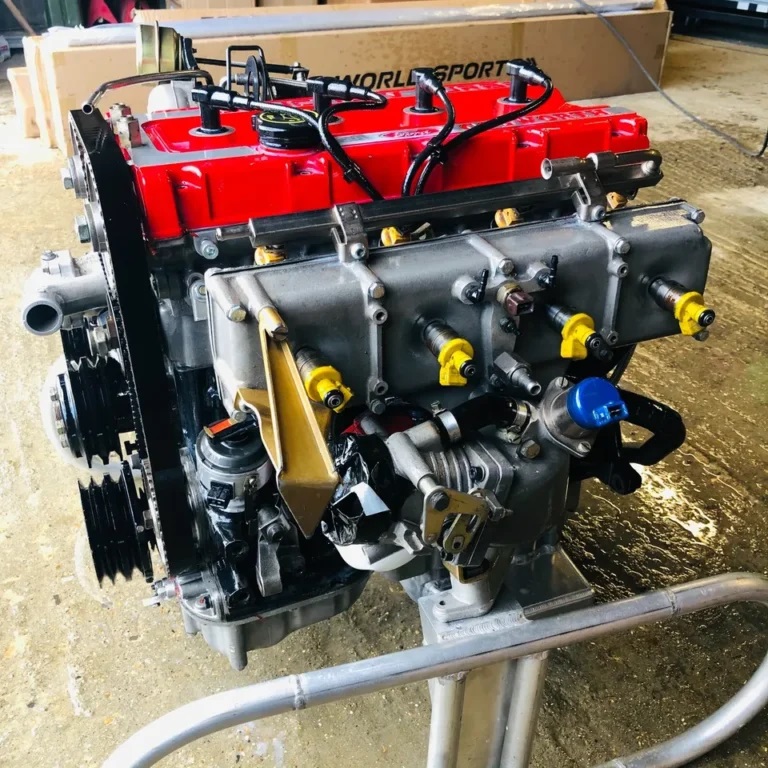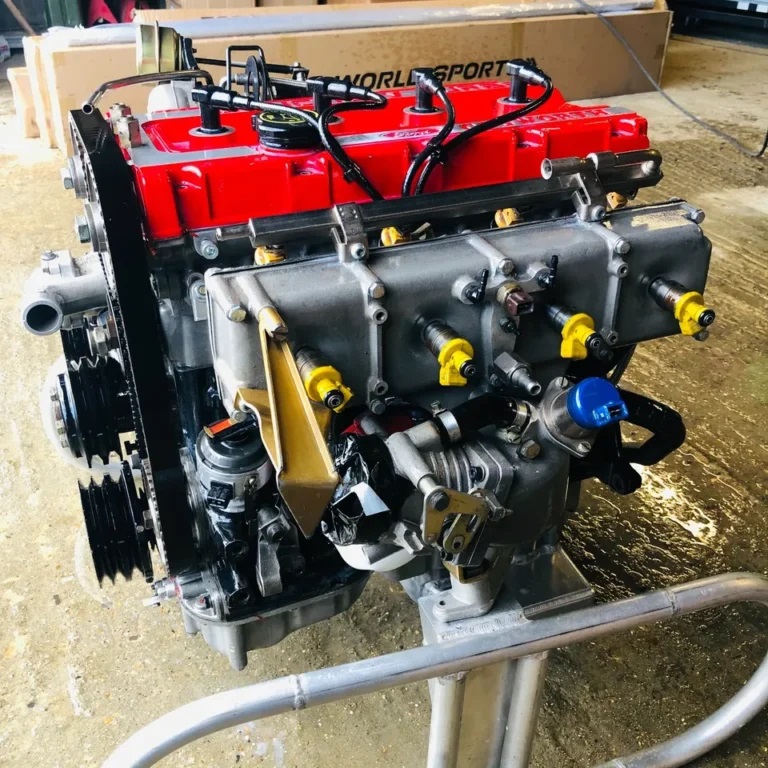

Cosworth DFX, DFR, DFZ and DFL (1976–1991)
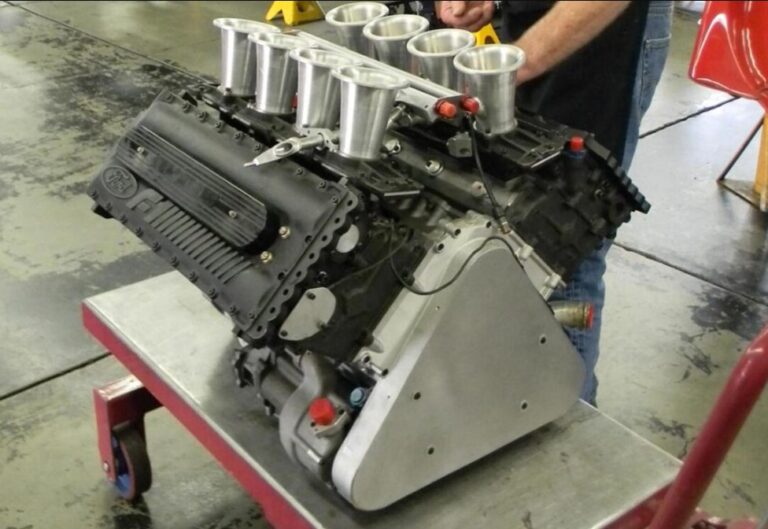
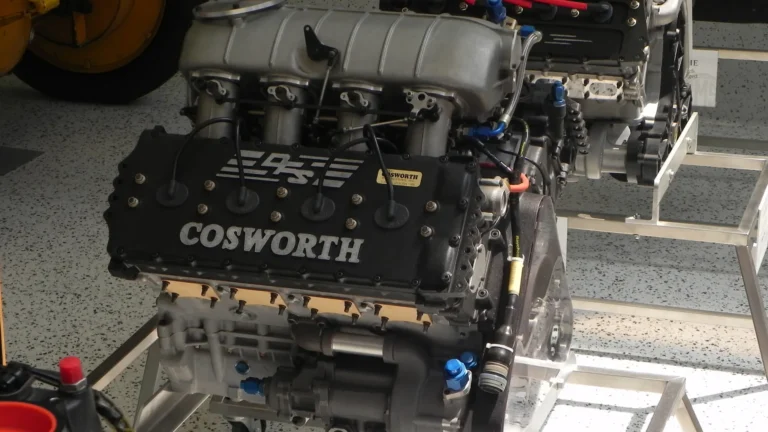
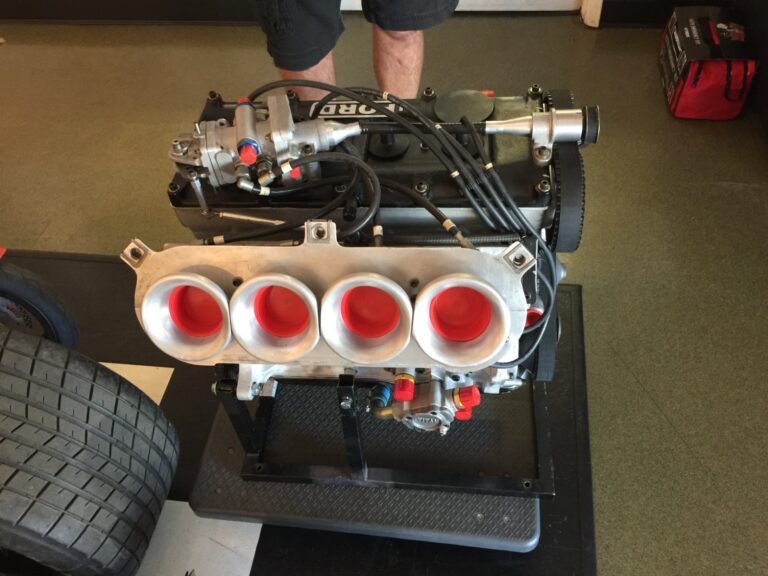
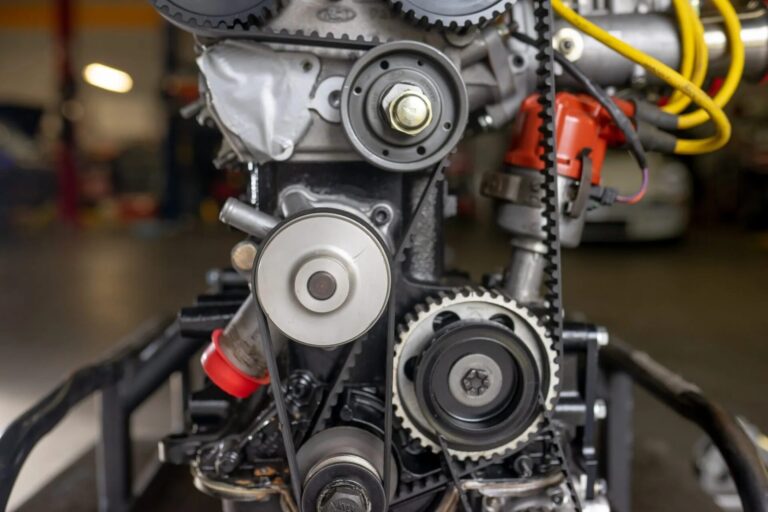
The DFX, DFL, DFZ and DFR are the main offspring of the Cosworth DFV V8. The turbocharged DFX ruled Indy car racing for a decade, the DFL served Group C, and the 3.5-litre DFZ and DFR closed the line in Formula 1. Owners of period Indy, Group C and late-1980s F1 cars need them to run correctly.
History
The DFX started outside Cosworth. In the winter of 1974–75 Parnelli Jones decided to turbocharge a DFV for Indy racing, and his VPJ shop destroked it to 2.65 litres 6. Al Unser gave it a first win at the Pocono 500 in June 1976 6. Cosworth then hired VPJ engine staff and opened a rebuild shop in Torrance, California 62.
By 1978 Cosworth quoted about 850 bhp at 9,500 rpm on 25 psi of boost 2. A new engine cost about £14,600 ex works that year 2. The DFX won ten straight Indianapolis 500s from 1978 to 1987 7. It was beaten in 1987 by the Ilmor V8 and gave way to the short-stroke DFS from 1989 38.
The DFL took the DFV into sports cars. Cosworth widened the bore to 90 mm and built a 3.3-litre version and a long-stroke 3.9-litre version 53. The 3.9 suffered from vibration that Cosworth never cured, and it was out of front-line use by 1985 1. The 3.3 found a home in the smaller C2 class, where lower tuning made it last 1.
In F1, the 1987 rules allowed 3.5-litre unblown engines next to turbos 1. Cosworth answered with the DFZ, a stopgap that won the Jim Clark Cup for Jonathan Palmer and Tyrrell 34. The DFR followed for Benetton in 1988 with about 80% new parts and a crank lowered by one inch 4. A planned Yamaha five-valve head missed its power target, so the DFR ran with four valves 4. It never won a Grand Prix, and its last F1 race was the 1991 Australian GP 1.
Palmarès
The DFX won its first race at Pocono in 1976 and then ten consecutive Indianapolis 500s from 1978 to 1987 67. It took every CART title from 1979 to 1987 and USAC titles from 1977 to 1979 1. It won 81 Indy car races in a row from 1981 to 1986 1. Rahal's 1989 Meadowlands win in a DFS was the 153rd and last for the family 8. The DFL gave Rondeau second in the 1982 world sportscar points and earned five Le Mans class wins from 1985 to 1990 1. The DFZ won the 1987 Jim Clark Cup and Colin Chapman Trophy with Tyrrell 4. The DFR never won a Grand Prix, but Benetton took third in the 1988 constructors' table 1.
What to check before you buy
Measure the stroke and confirm the capacity: Bore and stroke separate the family: 57.3 mm DFX, 64.8 or 77.7 mm DFL, 68.6 mm DFZ and DFR. Ask for the engine number and the last rebuild and dyno sheets: The family shares many castings, so paperwork and parts numbers prove which derivative you are buying. List exactly what comes with the engine: RCN DFX adverts include turbo and headers, a DFR advert has a harness but no ECU, and a DFS sold without turbo. Ask what rev limit the engine has run to: On DFV-family engines life drops sharply from 10,000 to 11,000 rpm, so rpm history sets the next rebuild date. On a DFR, do not assume DFZ parts fit: About 80% of DFR parts differ from the DFZ, including a lower crank position. On a DFX, ask for leak-down figures and piston inspection notes: Blow-by, exhaust valve heat and piston rocking were known DFX weak points in period. Confirm the target series accepts the engine before paying: Masters Racing Legends takes 3.0-litre F1 cars to 1985 only, and Group C Racing needs an FIA HTP or organiser passport. Ask who rebuilt it last: Known names include Langford & Peck for DFRs since 1989, Geoff Richardson and Race Engine Service of Midland, Texas.
Versions and evolutions
| Version | Years | What changed | How to identify |
|---|---|---|---|
| DFX | 1976–1987 | Destroked DFV, single turbo, methanol, thicker liners, RR58 forged pistons, crank with four counterweights, H-section rods 2 | 2,643 cc, 57.3 mm stroke, turbo plumbing and plenum; low 7.4:1 compression in 1978 US spec |
| DFL 3.3 | Early 1980s to 1990 (C2) | Bore raised to 90 mm with 64.8 mm stroke, about 490 bhp at 9,500 rpm 3 | 3,298 cc; 90 mm bore with stroke close to the DFV |
| DFL 3.9 | Early 1980s to about 1985 | Long 77.7 mm stroke, 3,955 cc, about 540 bhp at 9,250 rpm 3 | Longest-stroke member of the family; measure the stroke |
| DFY (context) | 1983–1985 | 90 x 58.8 mm short-stroke 3.0 for F1; second series with 22.5° valve angle instead of 32° 5 | Ford oval logo on the cam covers for the first time; lighter than a late DFV |
| DFZ | 1987–1988 | 3.5-litre stopgap for the non-turbo F1 class, about 565 bhp at 10,500 rpm 4 | 3,491–3,494 cc with 68.6 mm stroke; shares bore and stroke with the DFR |
| DFR | 1988–1991 | About 80% new parts versus the DFZ; crankcase redesigned to lower the crank by one inch for a smaller carbon clutch 4 | Same bore and stroke as the DFZ, so check the crankcase height and parts numbers rather than capacity |
| DFS | 1989–1992 | Short-stroke redesign of the DFX using DFR details and Nikasil liners 8 | 2.65-litre turbo like the DFX; confirm by stroke and build records |
Known issues
- Vibration in the long-stroke DFL 3.9 — Vibration that period sources call incurable; breakages and short life in long races 1
- DFZ vibration in sports cars — Spice reported severe vibration, breakages and running costs about four times those of the DFL in 1990 1
- DFX fuel curve mismatch — Injection did not follow the power curve, so engines ran about 20% rich to stay safe and about 30% rich at 7,000 rpm 2
- DFX damage on sharp lift-off — Transient throttle loads could not be reproduced on the dyno; Penske lost two engines at Ontario 2
- DFX heat and blow-by — Heavy heat load on standard DFV exhaust valves, excess blow-by and piston rocking on early US connecting rods 2
- Over-rev damage on DFR — A documented DFR over-rev broke a rod and drove a valve into the head; the wreck later sold as a display piece 9
- Valve and piston failures at high rpm (DFV family) — Tyrrell recorded 17 valve or piston failures in 30 DFV and DFY entries in 1983 5
Checklist before you buy
- Measure the stroke and confirm the capacity — Bore and stroke separate the family: 57.3 mm DFX, 64.8 or 77.7 mm DFL, 68.6 mm DFZ and DFR 1
- Ask for the engine number and the last rebuild and dyno sheets — The family shares many castings, so paperwork and parts numbers prove which derivative you are buying 7
- List exactly what comes with the engine — RCN DFX adverts include turbo and headers, a DFR advert has a harness but no ECU, and a DFS sold without turbo 17
- Ask what rev limit the engine has run to — On DFV-family engines life drops sharply from 10,000 to 11,000 rpm, so rpm history sets the next rebuild date 11
- On a DFR, do not assume DFZ parts fit — About 80% of DFR parts differ from the DFZ, including a lower crank position 4
- On a DFX, ask for leak-down figures and piston inspection notes — Blow-by, exhaust valve heat and piston rocking were known DFX weak points in period 2
- Confirm the target series accepts the engine before paying — Masters Racing Legends takes 3.0-litre F1 cars to 1985 only, and Group C Racing needs an FIA HTP or organiser passport 13
- Ask who rebuilt it last — Known names include Langford & Peck for DFRs since 1989, Geoff Richardson and Race Engine Service of Midland, Texas 10
Running costs 11
| Rebuild interval | DFX: rebuild every 600 miles in 1978 at Cosworth Torrance 2. DFV-family engine at 10,000 rpm: about 1,000 miles (Geoff Richardson) or 15–20 hours (Phil Reilly) 11. |
|---|---|
| Typical rebuild cost | No published DFX or DFR figure found. A full DFV refresh was quoted at £12,000–15,000 in 2016 11. |
| Consumables | Valve springs every rebuild; con-rod bolts, bearings, rings and seals renewed; pistons on condition 11. |
| Spares availability | Cosworth still supplied DFV parts in 2016 11. Langford Performance Engineering supports 3.5-litre era F1 engines 10. DFX turbo-specific parts not confirmed. |
Where it races today
- Masters Racing Legends · F1 cars 1966–1985, 3.0-litre — Takes DFV and DFY cars and, from 2026, 1977–1985 turbo F1 cars. 3.5-litre DFZ and DFR cars fall outside the dates. 13
- Peter Auto Group C Racing · C2a (1986–1990 spec) and C2b (1982–1985 spec) — DFL-powered C2 cars fit these classes; FIA Appendix K and a valid HTP or organiser passport required (2018 rules). 14
- Historic festivals, 3.5-litre F1 · Invitation — In 2022 organisers were considering 3.5-litre GP cars for historic festivals; no fixed series confirmed. 12
- Historic Indy car events · Unconfirmed — No current published rules found for DFX-powered Indy cars; check with event organisers. 6
Market prices
- COSWORTH DFX V8 Engine, 1980, private advert on RCN, Kansas: 13,000 USD (2024-12) 15
- Ford-Cosworth DFX Indy V8 Engine with turbo, headers and parts, RCN (two adverts): 19,000 USD (2025-09) 16
- Ford DFR Cosworth F1 engine, fresh with dyno time only, harness, no ECU, RCN: 13,400 USD (2026-08) 17
- Cosworth Ford DFR F1 engine, dealer asking price: 85,000 USD (2026-11) 18
- Cosworth Ford 3.3 DFL engine needing repair, dealer asking price: 45,000 USD (2026-11) 19
- Blown DFR mounted as a display piece: 18,000 GBP (2023-02) 9
- 1988 EuroBrun ER188 with refreshed DFR from Geoff Richardson, auction estimate: 225,000–275,000 GBP (2022-08) 12
As of November 2026, private RCN asks for DFX and DFR engines sit between $13,000 and $19,000, while a dealer asks $85,000 for a DFR. The gap reflects condition, completeness and rebuild paperwork rather than a clear price trend.
Reference prices are dated and sourced; live asking prices are in the listings above.
Frequently asked questions
How do I tell a DFR from a DFZ?
Capacity will not help, because both are 90 x 68.6 mm and about 3.5 litres. Taulbut records that about 80% of DFR parts differ, and the crankcase was redesigned to sit the crank one inch lower. Ask for parts numbers, the engine number and build records, and compare the crankcase with a known DFZ.
Is a DFX just a turbo DFV?
It began that way, but it differs inside. The stroke drops to 57.3 mm for 2,643 cc, and it runs methanol through mechanical injection. Cosworth used thicker liners, forged RR58 pistons, a crank with four counterweights and H-section rods. Treat it as its own engine when sourcing parts.
Can I race a DFR-engined F1 car in Masters Racing Legends?
Not on current published dates. The series covers F1 cars built from 1966 to 1985, with 3.0-litre engines, plus 1977 to 1985 turbo cars from 2026. DFR cars date from 1988. Check event invitations and festivals instead, and ask the organiser before you buy.
Why does the DFL 3.9 have a bad name?
Its long 77.7 mm stroke brought vibration that period sources describe as incurable. It left front-line racing by 1985. The shorter 3.3-litre DFL proved more usable in C2, where it was tuned for less power. A buyer should ask which version is fitted and how many hours it has run.
What does a DFX or DFR cost to run?
No published current rebuild price exists for either. In 1978 a DFX was rebuilt every 600 miles. A DFV-family engine at 10,000 rpm lasts about 1,000 miles, and a full DFV refresh was quoted at £12,000 to £15,000 in 2016. Get a written quote from the rebuilder before buying.
Sources
- Cosworth DFV, Wikipedia (2026) — Derivative specs, weights, users, DFX results, DFL and DFZ vibration, DFR results
- The Cosworth Turbo, Motor Sport (1978-02) — DFX bore, stroke, power, boost, turbo, injection, known problems, rebuild interval, 1978 price
- Cosworth DFV – Horses for courses (Graham Robson), Motor Sport (2007-07) — DFL capacities and power, DFL turbo project, DFZ and DFR power, Ilmor defeat, DFR hillclimb use
- Note 95: Best 3.5L NA engines in 1987 and 1988, D & M Taulbut, grandprixengines.co.uk (2016-01) — DFZ and DFR bore, stroke, power, rpm, weight, parts difference, crank height, Yamaha heads
- Note 88: The Cosworth DFY and F3000 engines, D & M Taulbut, grandprixengines.co.uk (2014-08) — DFL bore, DFY details, DFX crank and rod design, 1983 Tyrrell failures
- The Way It Is No. 533: Indy car racing's Cosworth revolution, Gordon Kirby (2016) — DFX origin at VPJ, first win, Cosworth Torrance shop, early results
- Cosworth DFX V-8 Engine, 1975-1985, The Henry Ford (2026) — Ten Indy 500 wins 1978–1987, part number markings, donors
- Ford Cosworth DFS Indy V8 engine, Silodrome (2026-05) — DFS years, final family win, Race Engine Service of Midland, Texas, sale without turbo
- Blown Cosworth DFR F1 engine, Silodrome (2023-02) — DFR over-rev failure, display engine price
- How to be an ace engineer: engine builder Richard Langford, Autosport (2022-10) — Langford & Peck history, DFR work since 1989, 3.5-litre era support
- Me an' my DFV, Primotipo (2016-05) — DFV-family rebuild intervals, refresh cost, consumables, Cosworth parts supply
- 1988 EuroBrun Cosworth DFZ F1, ER188-003 (Classic Sale at Silverstone), Iconic Auctioneers (2022-08) — Geoff Richardson DFR refresh, estimate, 3.5-litre cars at historic festivals
- Masters Racing Legends, Masters Historic Racing (2026) — Eligibility dates and engine capacity
- Group C Racing Regulations 2018, Peter Auto (2018) — C2 classes, Appendix K and HTP requirement
- COSWORTH DFX V8 Engine, Racing Car Network (2024-12) — DFX asking price
- Ford-Cosworth DFX Indy V8 Engine, Racing Car Network (2025-09) — DFX asking price and inclusions; duplicate advert at /ford-cosworth-dfx-indy-v8-engine-2/
- Ford DFR Cosworth Formula 1, Racing Car Network (2026-08) — DFR asking price and inclusions
- Cosworth Ford DFR Formula 1 engine - $85,000 USD, Indy Competition Services (2026-11) — DFR dealer asking price
- Cosworth Ford 3.3 liter DFL engine - $45,000, Indy Competition Services (2026-11) — DFL dealer asking price
- Ecosse efficient racer, Motor Sport (2004-04) — Ecosse switch to the DFL after DFV vibration, 1987 DFL results
Did you know
- Taulbut suggests the DFR name may mean 'Re-Born', since the DFZ looked like the last of the line 4.
- Cosworth planned a turbo DFL with twin Lanchester balancer shafts and a projected 700 bhp, but it was cancelled 3.
- The Henry Ford museum holds a DFX donated by Cosworth, Ronald W. Dawes and Bobby Unser 7.