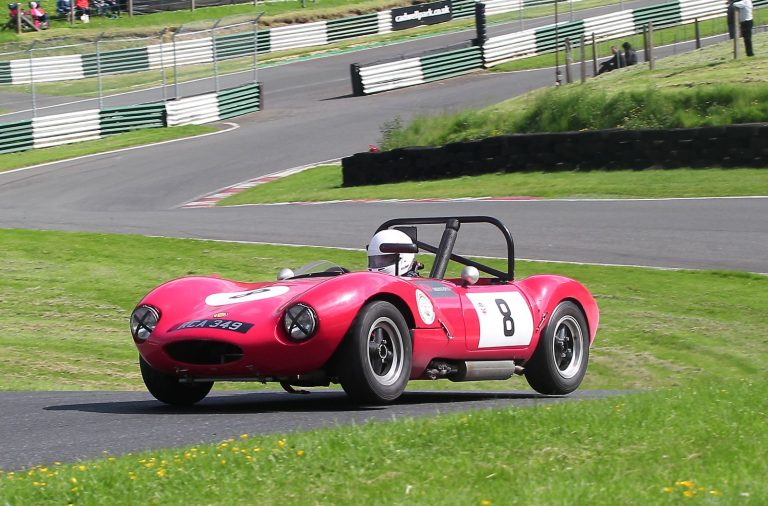

Ginetta G12 (1966–1968)
The G12 was Ginetta's mid-engined spaceframe GT prototype of 1966, sold as a rolling chassis and raced with engines from 997cc to 2 litres. Only about 28 to 35 were built in period. Today it is a light, eligible entry for 1960s GT and sports-prototype grids, with later Ginetta and Dare builds to tell apart.
History
Ginetta's G12 appeared in 1966 as a mid-engined step on from the successful G4. Ivor Walklett designed it around a steel tube spaceframe. A glassfibre cockpit section was bonded to the frame, while the nose and tail lifted off in one piece each 1. Ginetta sold it without engine or gearbox, so owners chose their own power and paired it with a Hewland transaxle 2. The kit cost £1,225 in period 2.
Chris Meek won first time out at Mallory Park in July 1966 2. Willie Green followed with a 997cc Cosworth SCA car and won 21 of his 23 races 1. The G12 reached the tracks some months before the Lotus 47 and Chevron B8 2. Once those 2-litre rivals arrived, the small Ginetta was outpaced, and by 1968 it was no longer a front runner 23. Ginetta then built the larger G16 for 2-litre and V8 engines 3.
How many were made is disputed. Ginetta historian Trevor Pyman puts the period total at 28 1. The Ginetta Owners Club gives 29 between 1966 and 1969 2. Former Ginetta technical director David Tearle quotes about 30 and also about 35 in period 3. An auction catalogue called chassis G12/3 one of 30 4. Several cars were later turned into road cars in the early 1970s 2.
The name returned more than once. Ginetta built a fresh batch for Japanese buyers from about 1989 to 1992 3. From 1993, after the company's receivership, three works continuation chassis were started, numbered on from the original sequence 3. The Walklett brothers' company Dare also built the G12 with a Cosworth YAC engine 11. In 2008 Ginetta Heritage said it could supply a complete G12 and planned a road version 1. Buyers should treat all of these as separate from the 1966 to 1968 cars.
Palmarès
Chris Meek gave the prototype a debut win at Mallory Park in July 1966 2. Willie Green won the 8 Clubs Silverstone race outright on 1 October 1966 10 and took 21 wins from 23 starts in his car 1. In the 1967 Motoring News GT series Paul Ridgeway won the 1150cc class 1. Peter Creasey took a class title in chassis G12/21 4. The RacingSportsCars archive holds 78 G12 entries from 1966 to 1973, with five outright wins and four more class wins 9. Eleven of those entries were in Germany, six at the Nürburgring 9.
What to check before you buy
Match the chassis number to the period sequence and history file: Period cars carry G12/n numbers; later works chassis use a 70xx sequence. Ask for build documents and cross-check entries in the RacingSportsCars archive. Read the FIA HTP: number, period, class and expiry date: Chassis G12/3 was papered as period G1, class GTP1, with expiry in December 2025. HSCC Guards Trophy points need an HTP or an HSCC VIF. Confirm the engine number and casting numbers are visible: Guards Trophy rules require the engine number plus original block and head casting numbers to be visible, and the engine must match the passport. Ask what limited-slip differential is in the Hewland: Guards Trophy bans gripper-type LSDs; only a period LSD is allowed, or the car is moved to an invitation class. Get hours since engine and gearbox rebuild, with invoices: G12/3 was sold with about 11.5 hours on its 2015 engine refresh and gearbox rebuild. Freshly built units should come with dyno sheets. Establish whether the car is period, a Japan batch car, a continuation or a Dare build: All carry the G12 name. Only the 1966 to 1968 cars have original race history; later builds need organiser approval in many historic classes. Check tyres against the target series: In the 2026 Guards Trophy, GT cars must use Dunlop L or M section tyres; period G cars may also use Dunlop CR65/82.
Versions and evolutions
| Version | Years | What changed | How to identify |
|---|---|---|---|
| G12 (original period car) | 1966–1968 | Spaceframe GT prototype sold less engine and gearbox. Launch engine 997cc Cosworth SCA; Lotus-Ford twin-cam common later; units up to 2 litres fitted by owners. 2 | Chassis numbers in the G12/n form (for example G12/3, G12-15, G12-21). Ask for period race entries and a history file tying the frame to that number. |
| G12P (Petit special) | c.1966–1968 | One-off coupe body built by Ford designer Richard Petit on a Ginetta rolling chassis with Lotus twin-cam and Hewland transaxle. Around fifty separate body mouldings. 12 | The original car is reported to be in Japan. The moulds later reached the UK and several replica bodies have been made, so a Petit-style body does not prove an original. |
| Ginetta later batch for Japan | c.1989–1992 | New cars built by Ginetta mainly for Japanese collectors, outside the original production run. One car was built with a Kawasaki engine for Kawasaki in 1989. 3 | Build date and paperwork from 1989 onward; not a period car for FIA purposes. Check the chassis number against Ginetta records. |
| Post-1993 works continuation chassis | after 1993 | Three works chassis started after the company changed hands, numbered on from the original 1970 sequence. Chassis 7032 runs an ex-Reynard Honda engine and has been hillclimbed. 3 | Four-digit chassis number in the 70xx range rather than the G12/n form. |
| Dare G12 | 1990s onward | New-build G12 from Dare UK, the Walklett brothers' later company, with subtle changes and a Cosworth YAC engine. The club lists a price of £43,032. 11 | Dare badging and build papers; Cosworth YAC engine. |
| Ginetta Heritage G12 | announced 2008 | Ginetta Heritage said it could supply 100% of a G12, including chassis, suspension and panels, and planned to sell it as a road car. 1 | Modern build records; no period race history. Treat as a new car, not a continuation of the 1960s chassis series, unless documents say otherwise. |
Known issues
- Frame flex with bigger engines — Willie Green found the twin-cam version less effective than his 1-litre car because the chassis flexed under the extra power. Expect handling to vary with engine choice and frame stiffening. 1
- Period crash damage and rebuilt frames — Chassis G12/3 was crashed early in 1967, passed through several owners as a project, and was rebuilt around 2012. Other cars may carry similar repairs. 4
- Engine specification differs car to car — Cars left the factory without engine or gearbox, so fitted units range from 997cc to 2000cc. The engine must match the FIA HTP or HSCC VIF for the class you plan to run. 2
- Hewland Mk9 transaxle wear — Documented cars have needed gearbox rebuilds or new Mk9 units: G12/3 had its box rebuilt in 2015, and a US car received a new Mk9 at restoration. 4
- Lapsed FIA papers — The HTP for G12/3, issued in 2015, ran only until December 2025. A car offered on papers of that age needs renewal before international events. 4
- Recommissioning after storage — Cars often sit unused. One vendor spent more than £12,000 freshening G12/3 after buying it in 2016, then raced it for about three hours. £12,000+ (2016-2021 example) 4
- Identity confusion with later builds — Ginetta built more cars for Japan from about 1989, three continuation chassis after 1993, and Dare built its own G12. Petit-style bodies have been made from the original moulds. 3
Checklist before you buy
- Match the chassis number to the period sequence and history file — Period cars carry G12/n numbers; later works chassis use a 70xx sequence. Ask for build documents and cross-check entries in the RacingSportsCars archive. 3
- Read the FIA HTP: number, period, class and expiry date — Chassis G12/3 was papered as period G1, class GTP1, with expiry in December 2025. HSCC Guards Trophy points need an HTP or an HSCC VIF. 4
- Confirm the engine number and casting numbers are visible — Guards Trophy rules require the engine number plus original block and head casting numbers to be visible, and the engine must match the passport. 6
- Ask what limited-slip differential is in the Hewland — Guards Trophy bans gripper-type LSDs; only a period LSD is allowed, or the car is moved to an invitation class. 6
- Get hours since engine and gearbox rebuild, with invoices — G12/3 was sold with about 11.5 hours on its 2015 engine refresh and gearbox rebuild. Freshly built units should come with dyno sheets. 4
- Establish whether the car is period, a Japan batch car, a continuation or a Dare build — All carry the G12 name. Only the 1966 to 1968 cars have original race history; later builds need organiser approval in many historic classes. 3
- Check tyres against the target series — In the 2026 Guards Trophy, GT cars must use Dunlop L or M section tyres; period G cars may also use Dunlop CR65/82. 6
Running costs 1
| Rebuild interval | No published interval for the G12 itself; depends on the engine fitted (Cosworth SCA, Lotus-Ford twin-cam or other). |
|---|---|
| Typical rebuild cost | Not published. One owner reported spending more than £12,000 freshening chassis G12/3 between 2016 and 2021 4. |
| Consumables | Dunlop L or M section historic tyres in HSCC Guards Trophy 6; Hewland Mk9 gearbox parts; Triumph-derived uprights and Girling discs 1. |
| Spares availability | In 2008 Ginetta Heritage said it could supply a complete G12 including chassis, suspension and panels, without an off-the-shelf parts list 1. |
Where it races today
- HSCC Guards Trophy (incorporating the Twin Cam Cup) · GT Prototype classes by capacity: GTF up to 1300cc, GTB Lotus twin-cam, GTA 1301-1650cc, GTC 1651-2000cc — For GT and GT Prototype cars built 1960 to 1969. Needs an FIA HTP or HSCC VIF. Cars built after the cut-off to period specification only with organiser approval. Twin-cam cars on Dunlop L or M tyres also score in the Twin Cam Cup. 6
- FIA international historic events · Period G1 (1966-1971), class GTP1 — Chassis G12/3 held HTP no. 38080 issued in 2015 in this period and class; it raced in the HSCC Guards Trophy from 2013 and finished second in class. 4
- Ginetta Heritage series and UK Historic Sports Racing & Prototypes one-hour races · Not stated — Named as suitable for the G12 by Motor Sport in October 2008. Check whether these series still run before relying on them. 1
Market prices
- G12 with history, estimate quoted by owner Spadge Hopkins: 50,000+ GBP (2008-10) 1
- 1967 G12/3 sports prototype, HTP to 2025, Coys auction, sold: 46,600 GBP (2016-01) 5
- Same car G12/3, Lotus-Ford twin-cam, Hewland Mk9, Silverstone Auctions Race Retro lot 216, sold: 53,438 GBP (2021-03) 4
Public results are scarce. The one car sold twice in public, G12/3, rose from £46,600 in January 2016 to £53,438 in March 2021. Dealer cars such as G12-15 (Canepa, May 2020) were offered at price on request.
Reference prices are dated and sourced; live asking prices are in the listings above.
Frequently asked questions
How many original Ginetta G12s were built?
Sources disagree. Ginetta historian Trevor Pyman estimates 28, and the Ginetta Owners Club says 29 between 1966 and 1969. Former Ginetta technical director David Tearle quotes about 30 to 35. Later Ginetta, continuation and Dare cars are extra to these totals and should not be counted as period cars.
Which engine does a G12 have?
There is no single answer. Ginetta sold the car without engine or gearbox. The launch cars used the 997cc Cosworth SCA, the Lotus-Ford twin-cam became the popular choice, and owners fitted units up to 2 litres. Documented race cars today mostly run 1600cc twin-cams with a Hewland Mk9 transaxle.
Can a G12 race in the HSCC Guards Trophy?
Yes, if it has an FIA HTP or an HSCC Vehicle Identity Form and meets Appendix K. The 2026 rules accept GT Prototypes built from 1960 to 1969, with classes by engine size and a separate Lotus twin-cam class. Chassis G12/3 has raced there and finished second in class.
Is a Dare G12 or a 1990s Ginetta G12 the same as an original?
No. Ginetta built a batch for Japan from about 1989 and started three continuation chassis after 1993. Dare built its own version with a Cosworth YAC engine. These are later builds without 1960s race history. Many historic series admit late-built cars only with organiser approval.
What does a good original G12 cost?
Public data is thin. Chassis G12/3, with FIA papers and a twin-cam, sold for £46,600 in January 2016 and £53,438 in March 2021. Motor Sport quoted at least £50,000 for a car with history in 2008. Factor in paper renewal and any rebuild hours.
Sources
- Ginetta G12 (Buyer's guide feature, Richard Heseltine), Motor Sport (2008-10) — Design, suspension, brakes, engines, Pyman build estimate, Green results, Ginetta Heritage revival, 2008 price estimate, suitable series
- Model - G12, Ginetta Owners Club (2026) — Production 29 (1966-1969), price new £1,225 less engine and gearbox, engine range, Meek debut win, road conversions, 1990 Japan revival
- Ginetta G12, David Tearle (2026) — Build figures 30 and 35, Japan batch 1989-1992, Kawasaki car, post-1993 continuation chassis, chassis 7032, G16 successor
- 1967 Ginetta G12 Sports Prototype FIA, lot 216, Iconic Auctioneers (Silverstone Auctions) (2021-03) — Chassis G12/3 history, HTP 38080 period G1 class GTP1 expiry Dec 2025, Guards Trophy results, rebuild hours, £12,000+ freshen, sold price £53,438
- Ginetta G12, COYS 16 January 2016, The Classic Valuer (2016-01) — Coys sale of G12/3 at £46,600
- HSCC Guards Trophy Championship Published Regulations 2026, Historic Sports Car Club (2026-04) — Class structure, HTP/VIF requirement, Twin Cam Cup, engine number rule, LSD rule, tyres
- 1967 Ginetta G12 (Canepa listing), Luxify / Canepa (2020-05) — Chassis G12-15 history, export to USA in 1967, FIA HTP, price on request
- 1967 Ginetta G12 race ready, race-cars.com (2026) — Ex-Paul Ridgeway car, 2005-2007 restoration, dry-sump twin-cam, new Hewland Mk9
- Ginetta G12, RacingSportsCars (2026) — Period entries 1966-1973, wins, class wins, frequent drivers and tracks
- 8 Clubs Silverstone, 1 October 1966, results, RacingSportsCars (1966) — Willie Green outright win in G12
- Model - Dare G12, Ginetta Owners Club (2026) — Dare G12, Cosworth YAC engine, listed price £43,032
- Model - G12 Petit, Ginetta Owners Club (2026) — G12P special body, moulds and replica bodies, original car in Japan
- Ginetta G12, Ginetta Owners Switzerland (2026) — Cross-check of years and engines; quotes more than 50 built (likely including later cars)
Did you know
- Willie Green bought his G12 after a Lola T70 order fell through, then won 21 of his 23 races in it 1.
- The first G12 believed to reach America, chassis G12-15, shipped from England in May 1967 aboard the Amsteldyk 7.
- The Ginetta Owners Club notes that several G12s were converted for road use in the early 1970s 2.
In the marketplace now
View all →No exact Ginetta G12 (1966–1968) listed right now — here is closely related machinery on the market.