
Renault Mégane Trophy (2005–2013)
A mid-engined, tube-framed Renault Sport racer with a Nissan-derived 3.5-litre V6 and a Sadev sequential gearbox. It ran in the Eurocup Mégane Trophy from 2005 to 2013 in two body generations. Today it is a rare, fast club GT and endurance car for buyers who can source specialist parts.
History
Renault Sport showed the Mégane Trophy at the Paris Motor Show in September 2004 9. It looked loosely like the Mégane II hatch but shared almost nothing with it. Under the composite skin sat a tubular spaceframe designed by Oreca 3. The engine was the 3.5-litre V4Y V6 from the Vel Satis, a Nissan VQ35 relative, reworked with Nismo 14. A Sadev six-speed sequential gearbox sat behind it 4.
The car was built for the Eurocup Mégane Trophy, a support series of the new World Series by Renault 5. The first season in 2005 had eight European meetings, starting at Zolder on 1 May 3. Renault quoted a car price under €100,000 and a season budget near €180,000 1. Maintenance was handled by Solution F, with Renault Sport Technologies providing support 1.
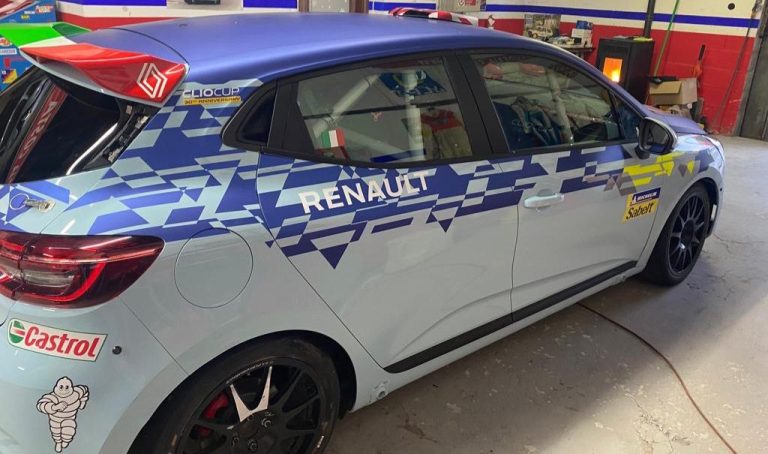
In October 2008 Renault unveiled a new body styled after the Mégane III coupé 2. It had scissor-type doors and a roof air intake, and power rose from about 330 to 360 hp 210. The chassis and mechanicals carried over. Renault offered the new body as a kit for existing cars, with chassis work done at the Alpine plant in Dieppe 210. The Mk II car first raced at Barcelona on 18 April 2009 with 22 entries 12. A 400 hp version is quoted for 2012 2.
The series ended after the 2013 season 5. Its replacement, the Renault Sport R.S. 01 of 2014, is a different car with a GT-R-derived V6 2. Many Trophy cars moved on to club GT and endurance racing, including the Dutch Supercar Challenge and the Dubai 24 Hour 1314.
Palmarès
The car decided the Eurocup Mégane Trophy title every year from 2005 to 2013 5. Champions included Jan Heylen (2005), Jaap van Lagen (2006), Nick Catsburg (2010), Stefano Comini (2011), Albert Costa (2012) and Mirko Bortolotti (2013) 5. Tech 1 Racing, TDS Racing and Oregon Team took the team titles 5. In private hands a Las Moras Racing car finished 16th overall in the 2012 Dubai 24 Hour, in class SP2 13. Cars also ran in the GT class of the 2012 Supercar Challenge 14.
What to check before you buy
Confirm the chassis number and whether the car is an original Mk II or a converted first-generation chassis: The Mk II body was sold as a kit for 2005–2008 cars, so looks alone do not prove the build year. Ask for kilometres since the last engine and gearbox revision, with invoices: The factory interval was 5,500 km, which a busy club season can use up. Ask which engine specification is fitted: 320–330 hp, 360 hp or the 2012 400 hp version: Output changed across the car's life, which affects class placement and parts needed. Make sure the Magneti Marelli software, laptop access and data system come with the car: The same electronics manage engine, gearbox and clutch, so the car cannot run without them. Check that the car has an engine, working gearbox and complete running gear: Display models and rolling chassis without engines have been sold under the Trophy name. Count the spare body panels and wheels offered, and inspect the composite for repairs: Panels are model-specific, and used body sets sell for high prices at auction. Check the FIA papers and the cage and crash-box condition against the chassis homologation: The tube frame was built to FFSA silhouette safety rules with front and side crash boxes.
Versions and evolutions
| Version | Years | What changed | How to identify |
|---|---|---|---|
| Mégane Trophy (first generation) | 2005–2008 | Original car with Mégane II-inspired composite body, 320–330 hp V6, Sadev sequential gearbox and Oreca spaceframe. 1 | Body echoes the Mégane II RS hatch with widened arches and a lowered stance. No roof air scoop. Early chassis numbers; ask for the original Renault Sport build history. |
| Mégane Trophy Mk II | 2009–2013 | New Mégane III coupé-style body with more downforce, scissor-type doors and a roof-fed intake. Power raised to 360 hp. Same chassis and drivetrain. 2 | Roof-mounted air scoop, scissor doors, Mégane III coupé headlight shape. Some are converted 2005–2008 chassis, so check the chassis plate and history. |
| Mk II, 2012 specification | 2012–2013 | Engine output quoted at 400 hp for the 2012 season. 2 | Not visible from outside. Ask for engine build sheets and ECU map details from the team that ran it. |
Known issues
- Race-built V4Y engine is not a road VQ35 — The unit was reworked with Nismo and runs a semi-dry sump. Road-car parts will not cover internals, sump or management. 1
- Short service interval on engine and drivetrain — Renault set revisions every 5,500 km. A car with unknown kilometres since its last revision should be treated as due. 10
- Sadev sequential gearbox with automatic clutch and paddles — The shift and clutch are controlled electronically. Faults can sit in the actuation or software rather than the gears. 8
- Period Magneti Marelli electronics — One system runs engine, gearbox, clutch and data logging. Missing software, looms or a dead unit can stop the car entirely. 8
- Model-specific composite bodywork — Panels are unique to each body generation. Used Mk II body sets have fetched over €12,000 at auction. €12,000+ for a used Mk II body set (2025) 7
- Converted cars and mixed identities — Many 2005–2008 chassis were rebodied to Mk II specification at Dieppe. The body alone does not date the chassis. 2
- Display models and part cars in circulation — Some 'Trophy' lots are show cars with no engine and a non-standard body. They are not race cars. 6
Checklist before you buy
- Confirm the chassis number and whether the car is an original Mk II or a converted first-generation chassis. — The Mk II body was sold as a kit for 2005–2008 cars, so looks alone do not prove the build year. 2
- Ask for kilometres since the last engine and gearbox revision, with invoices. — The factory interval was 5,500 km, which a busy club season can use up. 10
- Ask which engine specification is fitted: 320–330 hp, 360 hp or the 2012 400 hp version. — Output changed across the car's life, which affects class placement and parts needed. 2
- Make sure the Magneti Marelli software, laptop access and data system come with the car. — The same electronics manage engine, gearbox and clutch, so the car cannot run without them. 8
- Check that the car has an engine, working gearbox and complete running gear. — Display models and rolling chassis without engines have been sold under the Trophy name. 6
- Count the spare body panels and wheels offered, and inspect the composite for repairs. — Panels are model-specific, and used body sets sell for high prices at auction. 7
- Check the FIA papers and the cage and crash-box condition against the chassis homologation. — The tube frame was built to FFSA silhouette safety rules with front and side crash boxes. 1
Running costs 2
| Rebuild interval | Engine and drivetrain revision every 5,500 km (factory figure) |
|---|---|
| Typical rebuild cost | Unknown; no current published price found |
| Consumables | Michelin 18-inch slicks (8J front, 9J rear), steel discs and pads, fuel at about 40–45 litres per stint |
| Spares availability | No current factory parts programme found; panels and spares trade between teams and at auction |
Where it races today
- Eurocup Mégane Trophy (World Series by Renault) · One-make — Ran from 2005 to 2013, then folded. 5
- Supercar Challenge (Netherlands/Belgium) · GT (2012) — Cars from AFK Motorsport and Algarve Pro Racing entered in 2012. Current class placement not confirmed. 14
- Dubai 24 Hour (24H Series) · SP2 (2012) — Las Moras Racing ran one in 2012. Check the current 24H Series regulations before entering. 13
- Belgian Touring Car Series and other club GT or endurance events · Varies by organiser — Cars raced outside the Eurocup in Belgian and endurance events. Confirm acceptance and power-to-weight class with each organiser. 4
Market prices
- New car price, 2005 launch (Renault figure): under 100,000 EUR (2005-01) 1
- Season budget, 2005 Eurocup (Renault figure): about 180,000 EUR (2005-01) 1
- Mk II display model, no engine (Artcurial, The Renault Icons): 42,140 EUR (2025-12) 6
- Used Mk II body panel set (Artcurial, The Renault Icons): 12,040 EUR (2025-12) 7
In December 2025 a non-running Mk II display car made €42,140 against a €5,000–8,000 estimate 6. No running-car sale price could be confirmed from an open source as of November 2026.
Reference prices are dated and sourced; live asking prices are in the listings above.
Frequently asked questions
How do I tell the two generations apart?
The 2009–2013 Mk II has a Mégane III coupé-style body, scissor-type doors and a roof air scoop. The 2005–2008 car has a Mégane II-style body without the roof scoop. Many early cars were rebodied to Mk II form at Dieppe, so check the chassis number and history rather than the body alone.
Is this the same as the Mégane RS 225 Trophy or 275 Trophy?
No. Those are front-wheel-drive road cars with four-cylinder engines. The race car is mid-engined, rear-wheel drive and built on a tube frame with a 3.5-litre V6. Listings often mix the names, so check for the V6, the sequential gearbox and a racing chassis plate.
What engine does it use and can I get parts?
It uses the V4Y 3.5-litre V6, a Renault version of the Nissan VQ35 reworked with Nismo for racing. Basic architecture is shared with road VQ engines, but the semi-dry sump and race internals are specific. No current factory parts programme was found, so budget for specialist sourcing.
How often does it need a rebuild?
Renault set engine and drivetrain revisions every 5,500 km. That is roughly one busy club season of sprint and endurance racing. Ask the seller for kilometres since the last revision and invoices from the engine and gearbox builders.
Where can I race one today?
The original one-make series ended in 2013. Cars have since raced in the Dutch Supercar Challenge GT class and the Dubai 24 Hour SP2 class. Most open club GT and endurance series class cars by power-to-weight, so confirm with the organiser before you buy.
Is the Renault Sport R.S. 01 a newer Mégane Trophy?
No. The R.S. 01 replaced the Mégane Trophy in 2014 but is a separate design with a GT-R-derived V6 and a carbon chassis. Parts do not interchange in any useful way, and the cars sit in different price brackets.
Sources
- Mégane Trophy V6 (2005–2009), Planète Renault (2005) — First-generation specs, Nismo engine work, Solution F maintenance, price new, season cost, chassis safety rules
- Mégane Trophy V6 (2009–2013), Planète Renault (2008) — Mk II specs, brakes, weight, 2012 power figure, conversion kit at Dieppe, 5,500 km service interval, R.S. 01 succession
- Eurocup Mégane Trophy, Racecar.com (2005-03) — Oreca-designed tubular chassis, 320 bhp, 2005 calendar and entry
- Renault Mégane RS, Wikipedia (2026) — V4Y as rebadged VQ35DE, Sadev 6-speed sequential, use in Belgian touring and Dubai 24 Hour
- Eurocup Mégane Trophy, Wikipedia (2026) — Series years, champions and team titles 2005–2013, series end
- Lot 68: 2009 Renault Mégane III Trophy maquette, Artcurial (2025-12) — Display model result, estimate, early 320 bhp and later 360 bhp figures
- Lot 69: C.2009 Carrosserie Renault Mégane III V6 Trophy, Artcurial (2025-12) — Body panel set result, Mk II body features
- Renault Mégane Trophy, Ultimatecarpage.com (2005) — Semi-dry sump, Magneti Marelli control of engine, gearbox, clutch and data, brakes, about 30 cars
- 2005 Renault Mégane Trophy, Car Enthusiast (2004-09) — Paris 2004 unveiling, season cost estimate
- Renault Megane Trophy, LMP Cars (2008-10) — Mk II upgrade kit, Dieppe chassis work, 330 to 360 hp, 5,500 km interval
- Renault Sport gives UK debut to new Mégane Trophy at Autosport International, OneShift (2009-01) — Mk II 360 hp at 7,200 rpm, six-speed sequential
- New Mégane Trophy hits the track, Racecar.com (2009-04) — Mk II race debut at Barcelona, 22 cars
- 2012 Dubai 24 Hour, Wikipedia (2026) — Las Moras Racing Mégane Trophy, SP2 class, 16th overall
- 2012 Supercar Challenge, Wikipedia (2026) — Mégane Trophy entries in the GT class
- Renault technicians to tackle V6 Mégane racecar, GoAuto (2016-06) — Mk II 980 kg and 260 kW figures, 2013 Australian GP appearance
- Artcurial 2025-12-07 Renault Mégane Trophy, The Classic Valuer (2025-12) — Confirms 7 December 2025 sale date of the Artcurial display model
- File:FINRace Alastaro 2013 (9762974463).jpg, Wikimedia Commons (2013-09) — Image
Did you know
In the marketplace now
View all →No exact Renault Mégane Trophy (2005–2013) listed right now — here is closely related machinery on the market.