
Cosworth FVA and FVC (1966–1971)
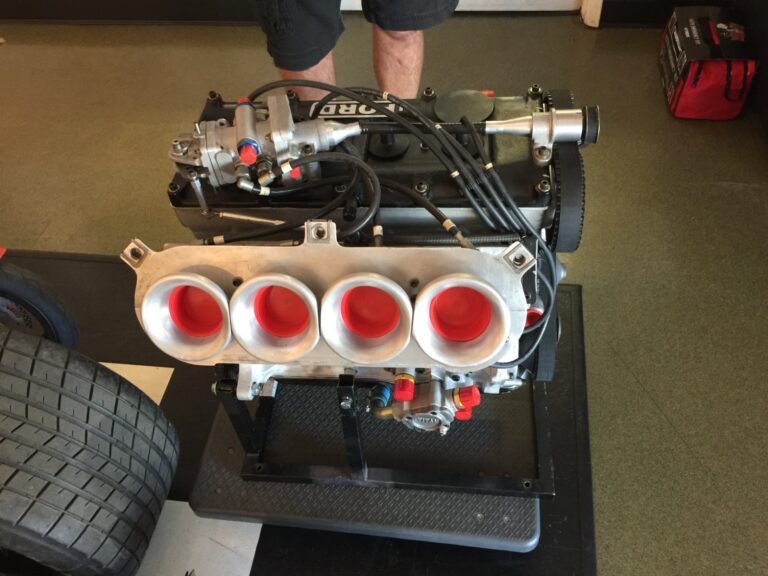
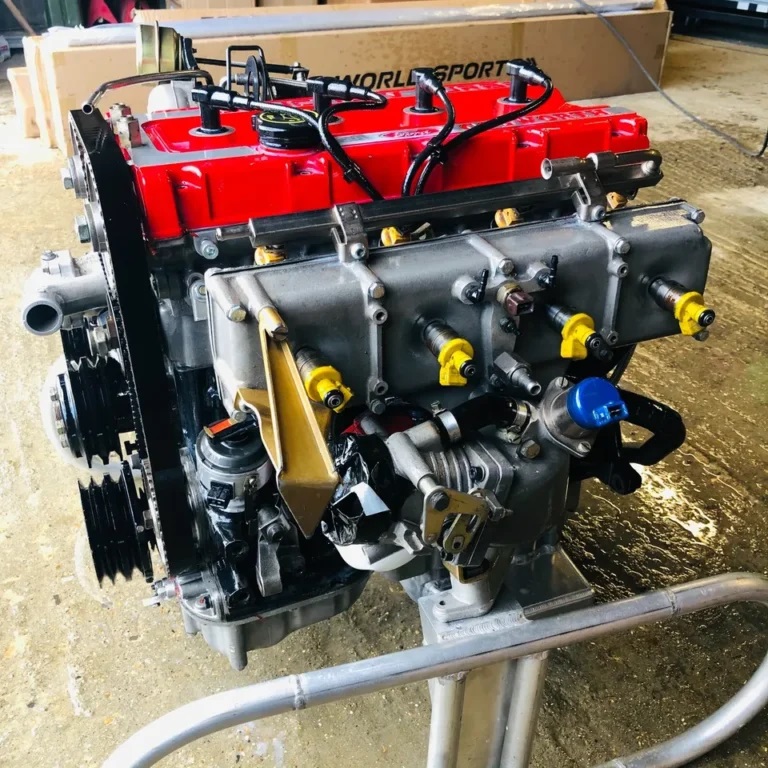
The FVA is Cosworth's 1.6-litre, 16-valve, gear-driven twin-cam built on a Ford production iron block for the 1967 Formula 2 rules. It dominated the 1.6-litre formula until 1971. The 1.8-litre FVC version became the standard engine of 1970–1971 two-litre sports racers such as the Lola T210/T212 and Chevron B19.
History
Ford paid for the FVA under the same contract that produced the DFV V8 for Formula 1 3. The four-cylinder came first and tried out much of the head design later used on the V8 315. A short-stroke 1.5-litre version, the FVB, was raced by Mike Costin in a Brabham at club meetings from July 1966 1. In early 1967 an FVB gave 200 hp, which Cosworth used to predict DFV output 1.
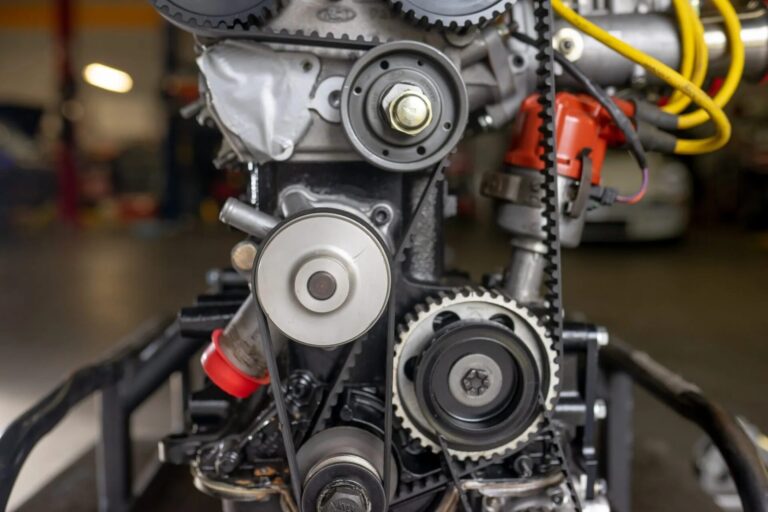
The 1967 Formula 2 rules demanded a production cylinder block, so Cosworth used Ford's five-bearing Cortina iron block 12. On top sat an aluminium four-valve head with a pent-roof chamber and twin cams driven by straight-cut gears from the crankshaft 2. A belt from the gear train drove the Lucas injection metering unit 23. Cosworth priced the engine at £2,500, and the first production run of 40 had sold out by March 1967 2. Period figures were 218–225 bhp at 9,000 rpm 316.
For 1969 Cosworth revised valve timing and port shapes, fitted a four-into-one exhaust and strengthened the con rods for higher revs 1. The 1970 rating was about 240 hp at 9,500 rpm 1. The FVA stayed the dominant F2 engine until the 1.6-litre formula ended after 1971 3.
The FVC arrived in 1969 as a larger-bore FVA of 1,790 cc, rated around 235 bhp 3. It suited the new European 2-litre sports car championship, where privateers could buy it off the shelf 6. Lola built 15 T210s for 1970 around it 6. By 1971 ten of the eleven drivers in the championship table used FVC power 5. The later FVD of 1975 moved to 1,975 cc and an aluminium block 3. The belt-driven BDA, built on a taller Kent block, reused the FVA breathing layout for road and rally use 15.
Palmarès
The FVA was the engine to have in 1.6-litre Formula 2 from 1967 until the formula ended in 1971 3. Matra drivers took the first three European F2 titles: Jacky Ickx (1967), Jean-Pierre Beltoise (1968) and Johnny Servoz-Gavin (1969) 4. Clay Regazzoni won in 1970 with Tecno and Ronnie Peterson in 1971 with a March 712M 4. In 2-litre sports cars, Jo Bonnier took the 1970 drivers' title in an FVC-powered Lola T210 6. Chevron won that year's makes' title by a single point 6. In 1971 Helmut Marko won the drivers' title and Lola the makes' title with 63 points 5. The 1971 table shows FVC engines in ten of the eleven classified drivers' cars 5. The T210 has kept winning in historic racing, including first overall at the 2011 Silverstone 1000 km 6.
What to check before you buy
Confirm it is a gear-driven FV engine, not a belt-driven BDA dressed up: A BDA is legal in place of an FVA in HSCC Historic F2, so many cars carry one; an FVA should have a front gear train driving both cams. Ask for the Lucas metering unit, injection pump and spark generator: The metering unit is belt-driven from the gear train, and the pump and spark generator lived on the chassis in period. Ask for crack-test results and an independent inspection report: Sellers of stripped FVAs have offered crack-tested components and specialist reports; without them you are buying blind. Measure bore and stroke: Confirms FVA (1,598 cc) versus FVC (about 1,790 cc) and shows how far the block has been bored. Ask for a recent dyno sheet and the builder's name: Listings of fresh engines quote dyno sheets and a named builder; compare power with the period 218–240 bhp range. Check the car's FIA Historic Technical Passport and engine type: HSCC Historic F2 requires an HTP and the type of engine originally fitted in international competition.
Versions and evolutions
| Version | Years | What changed | How to identify |
|---|---|---|---|
| FVB | 1966–1967 | Destroked 1.5-litre development engine; 1,498 cc and about 200 bhp; used to check expected DFV output 1 | Not a series-production engine; any claimed FVB needs period paperwork |
| FVA | 1966–1971 | 1,598 cc Formula 2 engine; 218–225 bhp at 9,000 rpm in 1967; revised ports, valve timing, exhaust and stronger rods from 1969 for about 240 bhp at 9,500 rpm 3 | Gear train at the front driving both cams, belt-driven Lucas metering unit, dynamo at the rear of the head driven from the exhaust cam, production iron block |
| FVC | 1969 onwards | Larger-bore FVA of about 1,790 cc for 2-litre sports racing; 235–250 bhp quoted 6 | Same gear-driven head layout as the FVA; capacity is the main difference. Lola Heritage quotes both 1,790 cc and 1,771 cc, so measure bore and stroke |
| FVD | 1975 | 1,975 cc on an aluminium block; about 275 bhp; context only 3 | Aluminium block rather than the iron Ford production block |
| BDA (not an FV engine) | 1969 onwards | Ford Kent-based twin-cam with toothed-belt cam drive and FVA-type breathing 15 | Belt cam drive and taller block; often fitted to historic F2 cars in place of an FVA |
Known issues
- Worn bores or liners — Sale descriptions of stripped FVAs report blocks needing new liners or bored oversize, one to 86 mm against an 85.7 mm standard bore 11
- Corrosion after long storage — One FVA stored for about 35 years showed water marks on the crankshaft near the main bearing oil grooves 12
- Stalled or incomplete rebuilds — Engines offered in pieces, without pistons, or with the crank stroke still undecided; one was abandoned mid-rebuild for lack of funds 12
- Missing injection and ignition ancillaries — The Lucas fuel pump and spark generator were chassis-mounted in period, so they are easily separated from the engine and lost 1
- Rod specification on uprated engines — Cosworth strengthened the con rods in 1969 for higher revs; ask which rods are fitted before using later rev limits 1
- Capacity and identity uncertainty — Published FVC capacities differ (1,790 cc and 1,771 cc), and listings sometimes describe one engine as FVA/FVC 6
Checklist before you buy
- Confirm it is a gear-driven FV engine, not a belt-driven BDA dressed up — A BDA is legal in place of an FVA in HSCC Historic F2, so many cars carry one; an FVA should have a front gear train driving both cams 8
- Ask for the Lucas metering unit, injection pump and spark generator — The metering unit is belt-driven from the gear train, and the pump and spark generator lived on the chassis in period 1
- Ask for crack-test results and an independent inspection report — Sellers of stripped FVAs have offered crack-tested components and specialist reports; without them you are buying blind 12
- Measure bore and stroke — Confirms FVA (1,598 cc) versus FVC (about 1,790 cc) and shows how far the block has been bored 3
- Ask for a recent dyno sheet and the builder's name — Listings of fresh engines quote dyno sheets and a named builder; compare power with the period 218–240 bhp range 9
- Check the car's FIA Historic Technical Passport and engine type — HSCC Historic F2 requires an HTP and the type of engine originally fitted in international competition 8
Running costs 2
| Rebuild interval | No published figure found in the sources checked |
|---|---|
| Typical rebuild cost | No published figure found; the 1967 new price was £2,500 2 |
| Consumables | Lucas mechanical injection parts, cam gear train and belt-driven metering unit drive should be inspected at each rebuild 23 |
| Spares availability | Not confirmed by sources; engines and projects still change hands as complete or partly rebuilt units 1112 |
Where it races today
- HSCC Historic Formula 2 International Series · Class A, Jochen Rindt Trophy — 1600cc F2 cars with wings, manufactured and raced before 1 January 1972; an FVA may be replaced by a BDA; FIA HTP required; continuation cars not eligible (2022 draft rules) 8
- HSCC Historic Formula 2 International Series · Class E, Jim Clark Trophy — F2, Formula Atlantic or Formula B cars without aerodynamic devices, built after 1 January 1967 (2022 draft rules) 8
- FIA Masters Historic Sports Car Championship · 2-litre sports racers — Lola T210/T212 with the FVC are accepted, per Motor Sport (2019) 7
- Peter Auto Classic Endurance Racing · 2-litre sports racers — Lola T210/T212 eligible, per Motor Sport (2019) 7
- HSCC Thundersports · 2-litre sports racers — Lola T210/T212 eligible, per Motor Sport (2019); check current class rules 7
- FIA Appendix K · Historic Technical Passport — The HSCC Historic F2 series runs under Appendix K of the International Sporting Code 8
Market prices
- New Cosworth FVA, factory price: 2,500 GBP (1967-03) 2
- Cosworth FVC engine, Clarkson Engineering build, dyno sheets, Lucas injection (RCN asking price, Seattle): 10,000 USD (2024-05) 9
- Cosworth FVC engine, Clarkson Engineering build (RCN asking price, Seattle, relisted): 10,000 USD (2025-07) 10
- Chevron B19 chassis B19-71-12 with new 1,790 cc engine, Aguttes Paris, sold incl. fees: 186,000 EUR (2024-12) 13
- Lola T210/T212 with FVC, complete car value range: 185,000–250,000 GBP (2019-12) 7
- Lotus 48 F2 (FVA), complete car value range, US guide: 75,000–100,000 USD (2015) 17
Public prices for bare FVA engines are rare; two stripped FVAs on race-cars.com were price on request and later marked sold (seen 2026-11). Complete FVC-powered sports racers sold between about €186,000 and £250,000 in 2019–2024.
Reference prices are dated and sourced; live asking prices are in the listings above.
Frequently asked questions
Can I race a historic F2 car with a BDA instead of an FVA?
In the HSCC Historic Formula 2 International Series, yes. The 2022 draft rules state that a Ford Cosworth FVA may be replaced by a BDA. Other series may differ, so read the current rules. A BDA-engined car should not be priced as if it carried a genuine FVA 8.
What is the difference between an FVA and an FVC?
How much power should a healthy FVA make?
What does an FVC engine cost?
Sources
- Note 79: Comparison of Climax FPF with Cosworth FVA, Grand Prix Engines (D & M Taulbut) (2013-08) — Bore and stroke, compression, power, max rpm, weight, block, FVB history, 1969 changes, price
- Prospects for Formula Two, Motor Sport (1967-03) — Price, first production run of 40, block, cam drive, injection, users
- Cosworth, Wikipedia (2026) — Engine table for FVA, FVB, FVC, FVD; Ford contract; F2 dominance until 1971
- Formula 2 index, OldRacingCars.com (2026) — European F2 champions 1967–1971 and their cars
- European 2-litre Sports Car racing 1971, OldRacingCars.com (2026) — 1971 results, FVC share of the field
- Lola T210, Lola Heritage (2026) — T210 numbers, FVC capacity and power, 1970 titles, historic wins
- Speedshop: race car buying, Lola T210/T212, Motor Sport (2019-12) — T210/T212 numbers built, current series eligibility, price range
- HSCC Historic Formula 2 International Series Draft Regulations 2022, Historic Sports Car Club (2021-11) — Classes, HTP requirement, FVA-to-BDA substitution, Appendix K
- Cosworth FVC Engine (stock 6870), Racing Car Network (2024-05) — Asking price, builder, injection, dyno sheets
- Cosworth FVC Engine (stock 8435), Racing Car Network (2025-07) — Asking price, relisting
- Cosworth FVA F2 Engine, race-cars.com (2026) — Partly rebuilt FVA, liners, head rebuilt by CES
- Cosworth FVA, race-cars.com (2026) — Stored FVA condition, crack testing, bore size, crank corrosion
- Chevron B19 1971, chassis B19-71-12, lot 73, Aguttes (2024-12) — Sale result with new 1,790 cc engine
- Focus: the 1967 FVA-powered Ford Cortina Lotus Mk2, Historic Motorsport Central (2015-01) — Nine-gear cam drive, metering unit and dynamo drives
- The Cosworth BD engine, Historic Motorsport Central (2014-04) — BDA belt drive on taller Kent block, FVA breathing shared
- Lotus 48 Cosworth specifications, Ultimatecarpage.com (2026) — Bore and stroke, 218 bhp
- F2 / Atlantic / FB Race Car: 2015 Market & Price Guide, Supercars.net / Sports Car Digest (2015) — Lotus 48 and other F2 car value ranges
- Aguttes La Vente d'Automne, December 1, Paris, Racecar.com (2024-11) — Sale date and estimate for the Chevron B19-FVC